

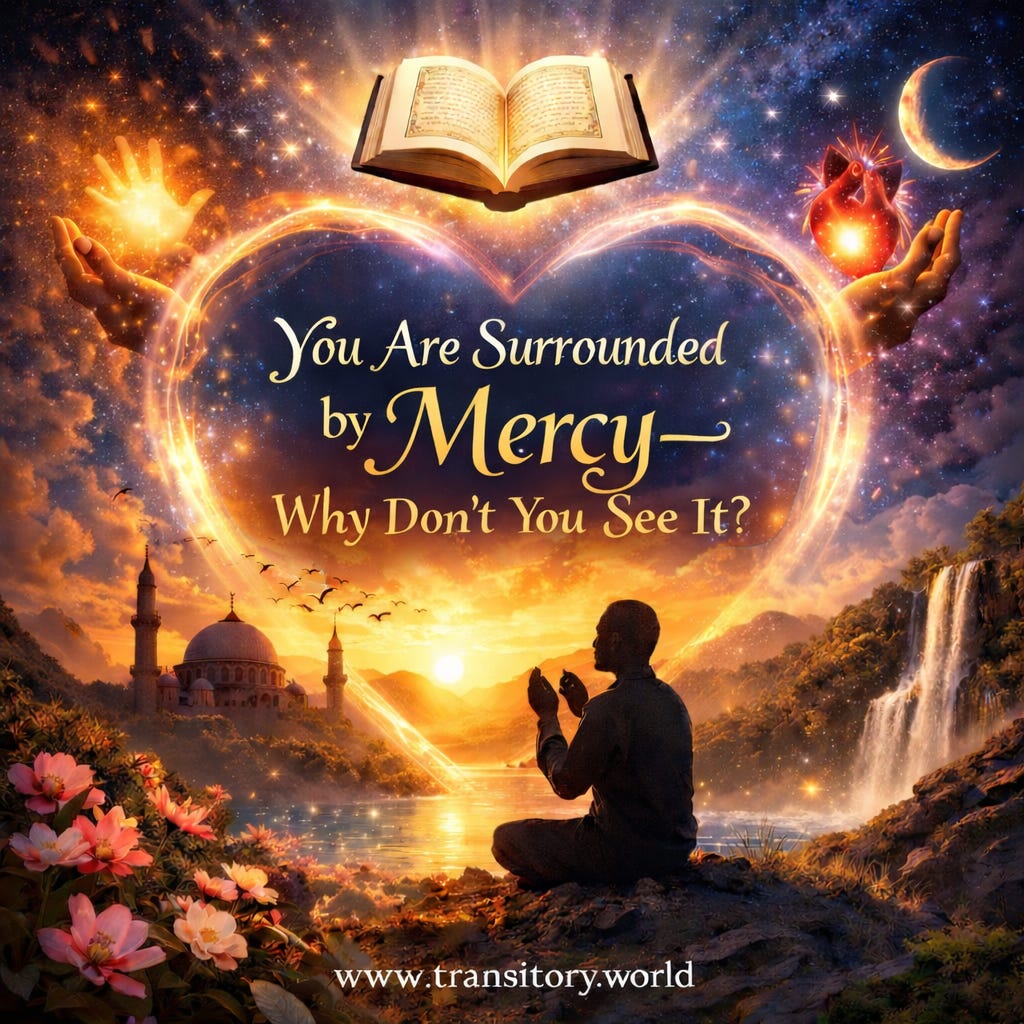
In our fast-paced world, we often find ourselves rushing from one task to another, barely pausing to appreciate the countless blessings that surround us. Yet, there is an ancient wisdom that reminds us: gratitude is not just a polite gesture, but a transformative spiritual practice that can change our entire relationship with existence.
The Divine Call to Thankfulness
Throughout the Quran, we find over 2,500 verses that invite us to pause and contemplate the signs of the Divine in creation. One such verse asks humanity a profound question: “Will you not be grateful?” This question appears repeatedly in various forms, drawing our attention to the countless blessings we receive daily.
Consider the cycles of nature. The Quran speaks of how the earth appears lifeless in winter, only to be revived with vibrant life in spring. This natural rhythm is not random, it is a sign meant to awaken gratitude within us. As the Quran reminds us, Allah has created countless creatures—cattle, sheep, and other animals—that provide us with milk, meat, and materials for our use, all functioning day and night without pause.
Yet despite these endless gifts, humans often fall short in expressing thankfulness. This lack of gratitude, according to Islamic teaching, is a sign that negative forces have begun to influence the heart. The tradition warns that persistent ingratitude can eventually cause faith itself to diminish, leaving a person spiritually disconnected.
The Promise of Increased Blessings
One of the most beautiful verses in the Quran states: “If you are grateful, I will surely increase you [in favor]” (Surah Ibrahim 14:7). This divine promise reveals a profound spiritual principle: gratitude is not just about acknowledging what we have, it actually opens the door to receiving more blessings.
But what does it mean to be truly grateful? It goes beyond simply saying “thank you.” True gratitude involves recognizing the Source of all blessings and allowing that recognition to transform how we live, act, and treat others.
A Night of Tears: The Prophet’s Example
One of the most moving illustrations of gratitude and contemplation comes from a story narrated by Aisha, the wife of Prophet Muhammad. She recalled a particular night when the Prophet was standing in prayer. After performing ablution, he stood in worship and began to cry.
He cried while standing. He cried while bowing. He cried while prostrating. He continued crying throughout the entire night until the morning call to prayer.
When asked why he wept so intensely—especially since he had been promised forgiveness—the Prophet responded with a question: “Should I not be a grateful servant?”
This profound response teaches us that gratitude is not conditional on our status or accomplishments. Even when all sins are forgiven, even when success is guaranteed, the appropriate response to divine mercy is still deep, heartfelt gratitude. The Prophet’s tears that night were sparked by certain verses that had been revealed to him—verses that invited deep contemplation of God’s signs in creation.
Tafakkur: The Art of Contemplation
The practice the Prophet demonstrated that night is called tafakkur in Arabic—deep contemplation or reflection. Islamic scholars describe this as “the shortest path to reaching the Divine.” It involves pausing to truly observe and reflect on the signs all around us.
Interestingly, the Quran often speaks in the present tense when describing divine actions. It doesn’t just say God created the universe; it emphasizes that God is continuously active, creating and sustaining every moment. The verse states: “We send down water from the sky”—not “we sent” but “we send,” emphasizing the ongoing, present reality of divine care.
This linguistic choice invites us to recognize that blessings are not just historical events but ongoing realities. The Earth has been stable for billions of years. The sun rises each day. Water continues to fall from the sky. These are not accidents but signs of a continuous, loving presence sustaining all of existence.
The Hidden Danger: Fearing Creatures Instead of the Creator
One of the deeper spiritual teachings in Islamic thought concerns what is called “hidden shirk”—hidden forms of associating partners with God. This doesn’t necessarily mean worshiping idols; it can be as subtle as fearing other humans more than fearing God, or placing your trust in worldly powers rather than in the Divine.
The teaching states clearly: if you fear other people—tyrants, oppressors, or any human authority—more than you fear God, then you have a form of spiritual corruption in your heart. True faith means recognizing that ultimate power belongs only to the Divine, and no worldly force can ultimately harm or benefit us without divine permission.
This doesn’t mean being reckless or naive about worldly dangers. Rather, it means maintaining perspective: our ultimate trust, our ultimate fear, and our ultimate hope should be directed toward the eternal reality, not temporary circumstances.
Seeking Spiritual Healing
Many of us go through life experiencing difficulties, setbacks, and suffering. Yet we often seek solutions only in the material realm—better jobs, more money, different relationships. While these practical steps have their place, Islamic wisdom teaches that true healing requires spiritual work.
The tradition emphasizes the importance of turning to spiritual guides and righteous people for healing and guidance. These are individuals who have purified their own hearts and can help others on the path. A profound prophetic teaching states: “Whoever shows enmity to a friend of Mine, I declare war against them.” This highlights the special status of those who dedicate their lives to spiritual growth and service.
When we experience difficulties, the teaching encourages us to return to our spiritual foundations—to reconnect with prayer, with remembrance of God (dhikr), and with communities of faith. This is where true healing begins.
The Inner Work: Purifying the Heart
Perhaps the most important teaching in this wisdom tradition is that external success without inner purity is hollow. You can recite prayers, perform rituals, and follow all the outward forms of religion, yet if your heart remains impure—filled with arrogance, hatred, greed, or fear—you have missed the essence.
The story of Iblis (Satan) serves as a cautionary tale. Before his fall, Iblis was the teacher of angels, possessing vast knowledge and performing great acts of worship. Yet hidden within his heart was arrogance and a sense of superiority. When tested, this hidden corruption revealed itself, and he fell from his high station to become the rejected one.
This teaches us that spiritual rank is not about external appearances or even knowledge. It’s about the state of the heart. That’s why the Islamic tradition emphasizes the necessity of dhikr (remembrance of God), following a spiritual teacher, and engaging in consistent inner work to purify the heart at all levels.
The Layers of Secrecy
Islamic mysticism speaks of different levels of hidden aspects within us:
Sirr (Secret): Things hidden from the public but known to your family and close ones
Khafi (Hidden): Things hidden from everyone except yourself
Akhfa (Most Hidden): Things hidden even from yourself, known only to God
This framework reminds us that we don’t even fully know ourselves. There are aspects of our character, motivations, and inner states that remain hidden even from our own awareness. Only the Divine has complete knowledge of what lies within us. This should cultivate both humility and the motivation to seek deeper self-knowledge through spiritual practice.
The Crisis of Our Time
Looking at the state of the world today—particularly the difficulties facing Muslim communities—Islamic teachings suggest that the root cause is spiritual disconnection. When individuals and communities neglect their inner spiritual life, they become weak, divided, and susceptible to external manipulation.
The solution is not primarily political or economic, though these have their place. The fundamental solution is spiritual revival: turning hearts back to the Divine, purifying intentions, cultivating love for truth and justice, and building genuine spiritual communities.
This teaching applies universally. Whether Muslim or not, any individual or community that neglects the spiritual dimension of life—that fails to cultivate gratitude, contemplation, compassion, and connection to something greater than the material world—will eventually face inner emptiness and outer conflict.
Practical Steps Forward
So how do we begin to cultivate this grateful, contemplative, spiritually alive way of being? Here are some practical steps:
Daily Contemplation: Take time each day to truly observe the world around you. The sky, trees, your breath, the food you eat. Let yourself feel wonder and gratitude.
Express Thanks: Make it a practice to consciously thank the Source of all blessings throughout your day, not just during formal prayer times.
Seek Knowledge and Guidance: Learn from those who have walked the spiritual path before you. Read sacred texts, listen to teachings, and if possible, find a mentor or community to support your journey.
Inner Work: Be honest with yourself about your character flaws, fears, and negative patterns. Work consistently to purify your heart through prayer, meditation, service to others, and self-reflection.
Consistent Practice: Like the Prophet’s all-night prayer, spiritual growth requires consistency and dedication. Set aside regular time for your spiritual practice, whatever form that takes.
Community: Don’t try to walk the path alone. Connect with others who share your spiritual values and aspirations.
A Universal Message
While these teachings come from the Islamic tradition, their essence is universal. Every wisdom tradition recognizes the transformative power of gratitude. Every spiritual path emphasizes the importance of inner purification. Every religion warns against the dangers of materialism and ego.
What makes this teaching particularly powerful is its emphasis on the continuous, present-tense nature of divine blessings. God is not a distant force who created the world long ago and then stepped back. Rather, the Divine is continuously active, continuously giving, continuously sustaining every moment of existence.
When we recognize this, our entire experience of life shifts. We stop taking things for granted. We stop feeling entitled. Instead, we move through life with a sense of wonder, humility, and deep gratitude for the gift of existence itself.
The Path of Light
I want to conclude with a beautiful metaphor: just as a fish is completely immersed in water, we human beings are completely immersed in the blessings and mercy of the Divine. We swim in an ocean of grace, whether we recognize it or not.
The question is: Will we wake up to this reality? Will we open our eyes to see the countless blessings surrounding us? Will we open our hearts to feel genuine gratitude?
Those who do embark on this path of gratitude, contemplation, and inner purification become sources of light and peace for others. They embody the spiritual qualities that the world desperately needs: compassion, wisdom, integrity, courage, and love.
This is the invitation extended to every human being: to move beyond mere survival and success, and to awaken to the deeper dimensions of existence. To become not just consumers of blessings, but grateful recipients who, in turn, become blessings for others.
As we face the challenges of our time—whether personal struggles or global crises—let us remember that the solution begins within. By cultivating gratitude, by engaging in deep contemplation, by purifying our hearts, and by reconnecting with the Source of all goodness, we transform not only ourselves but also contribute to the transformation of the world.
May we all be granted the wisdom to recognize our blessings, the courage to be grateful in all circumstances, and the spiritual strength to walk the path of inner purification. And may we become, in whatever small way we can, sources of light and mercy in a world that desperately needs both.