

There is a question so vast that most of us learn the answer before we are old enough to truly ask it.
Why was I created?
We recite the answer from childhood:
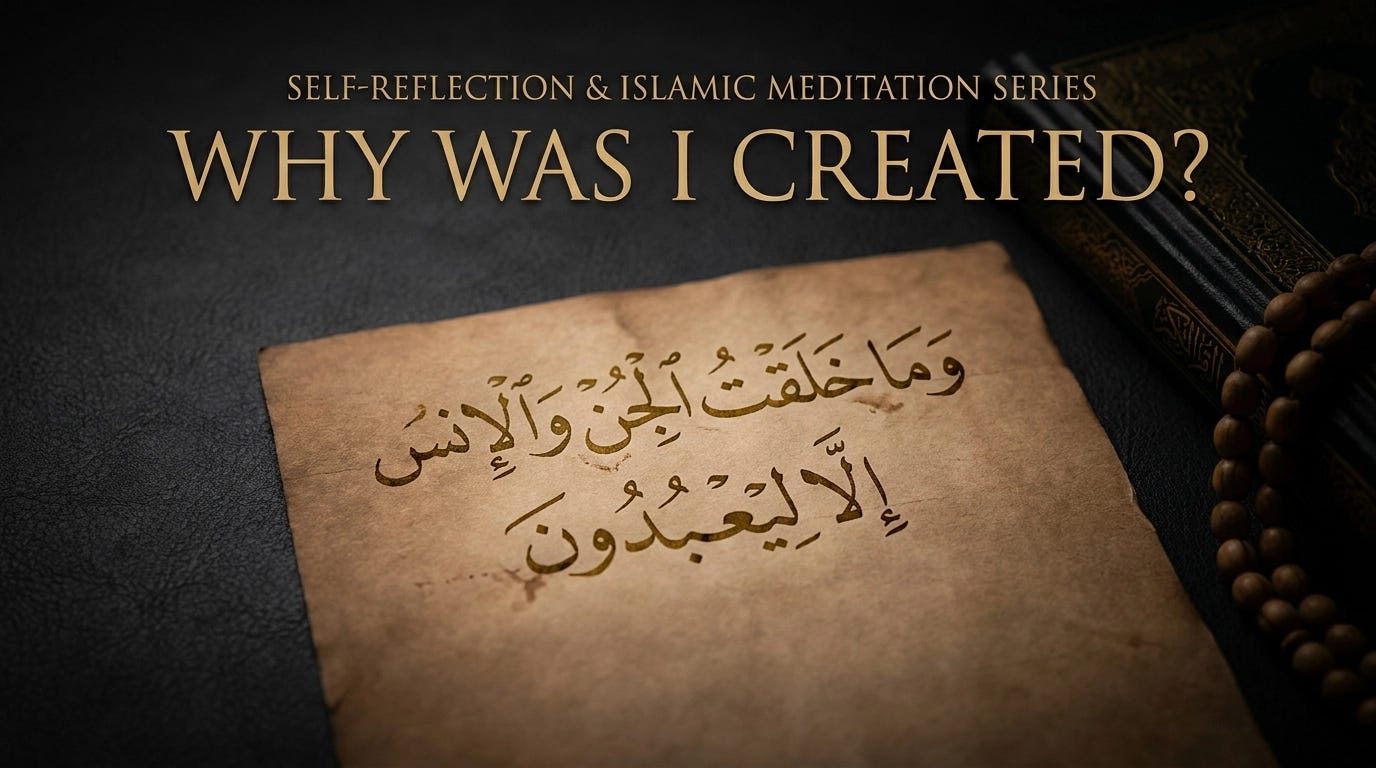
“And I did not create the jinn and mankind except to worship Me.”(Surah Adh-Dhariyat, 51:56)
And then, for many of us, the question closes — as if answering it were enough. As if the word worship needed no further unfolding.
But lately, I have been sitting with this question again. Not as a student reciting a lesson, but as a person living a life — with a job, with colleagues, with products that reach people I will never meet. And I am no longer sure the answer is as compact as we often treat it.
Yes, Allah created us to worship Him.
The five pillars of Islam are not a suggestion — they are the foundation. The Shahada, the five daily prayers, fasting in Ramadan, Zakat, and Hajj. These are not optional additions to a Muslim life; they are its structure. Without them, nothing else holds its shape. This is the baseline that every believer is called to reach.
But a baseline is not a ceiling.
Subhanallah — consider what it would mean if worship ended at the prayer mat. If every moment spent outside of formal ibadah were somehow outside of Allah’s view, outside of His mercy, outside of meaning. What a diminished world that would be. What a diminished God we would be imagining.
The Prophet ﷺ said that even a smile toward your brother is an act of charity. That removing something harmful from the road is charity. That easing another person’s burden is worship. These are not metaphors. They are instructions.
When I go to work tomorrow, I will not be stepping outside of worship. I will be entering a different room of it.
My colleagues — their ease, their growth, their dignity in the workplace — this is a trust I carry. The products my work contributes to — whether they genuinely help someone live a simpler, less burdened life — this too is an act of service, offered in Allah’s name, whether or not anyone knows it. And if I do it with that intention, with the niyyah that this is my form of mercy toward those I may never see — then it becomes ibadah. Not despite being ordinary. Because it is ordinary, and I am doing it consciously.
Allahu Akbar — He did not create us to retreat from the world. He created us to move through it as His representatives: merciful, honest, careful with other people’s time and wellbeing, attentive to the trace we leave behind.
“And We have not sent you, [O Muhammad], except as a mercy to the worlds.”(Surah Al-Anbiya, 21:107)
Not only to the mosque. To the worlds.
And if we are created to worship the One who is Ar-Rahman, Ar-Rahim — the Most Merciful, the Most Compassionate — then perhaps worship, in its fullest form, is the practice of mercy. Toward those we know. Toward those we serve. Toward those who will never know our name.
So why were you created?
Not only to pray — though prayer is where it begins.
Not only to fast — though fasting teaches the body its place.
You were created to be a small, specific, unrepeatable expression of Allah’s mercy in the exact corner of the world you inhabit. To do your work well. To treat people as though they matter — because they do. To leave every room, every conversation, every product, every interaction slightly better for your having been there.
The question was never meant to close.
How much of your daily life — your ordinary, unheroic, Tuesday-afternoon life — is already worship, if you were to offer it consciously to Allah?