

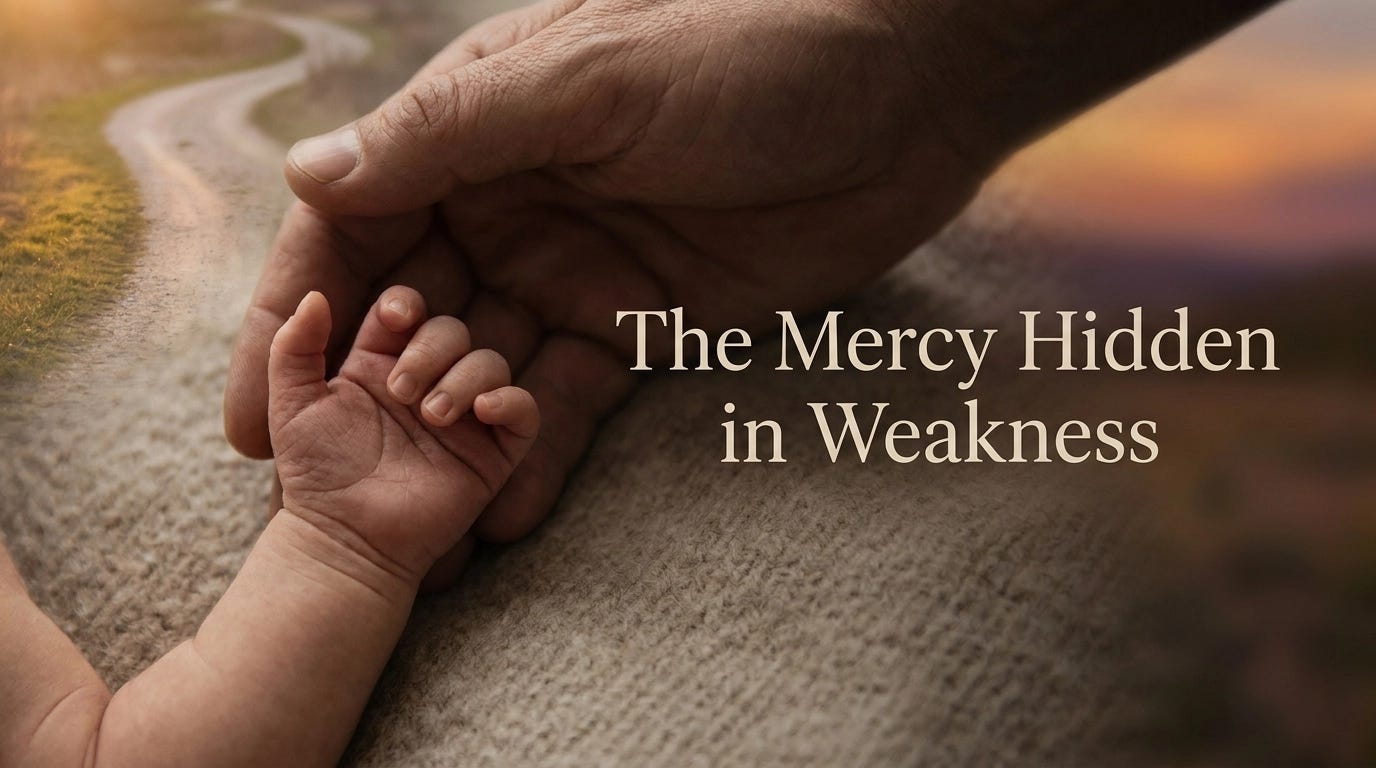
A human baby enters the world in a condition unlike most creatures around it.
It cannot walk. It cannot feed itself. It cannot protect itself. It cannot even hold up its own head. For a long time, it is completely dependent on others — on a mother, a father, a pair of hands, a voice, a body that carries it, feeds it, washes it, warms it, and answers its cry.
And this is strange when we compare it to so much of the animal world.
A calf is born and soon tries to stand. A foal begins to find its legs. Many animals enter life with a kind of readiness already placed inside them. They may still need protection, but their bodies seem to know quickly what survival requires. Some animals are left almost entirely on their own. Some must run, follow, search, or escape very early.
But we do not.
We begin almost as nothing.
Not nothing in worth — never that. The human being is honored by Allah. But in ability, in physical independence, in self-sufficiency, we begin from the deepest weakness. We arrive unable to manage even the smallest need by ourselves.
And maybe this is one of the first lessons Allah writes into the human life.
Before we learn language, before we learn pride, before we learn to say “I did this” or “I built this myself,” our bodies already carry a memory: I was helpless. I was carried. I was given strength.
There is a mercy in the way animals are created. Imagine if a cow gave birth to a calf that could not walk for months. Imagine the weight of that animal needing to be carried everywhere, lifted, moved, protected, and fed by human hands in the way an infant is cared for. It would place a burden on people that would be almost impossible. So Allah, in His wisdom, gives many animals an early strength. Their ability to stand quickly is itself a mercy.
But with the human being, Allah gives another kind of mercy.
He allows us to begin weak.
He lets our life open with dependence.
He makes our first chapter one in which we cannot survive unless care descends upon us from outside ourselves.
And if we sit with this long enough, it becomes deeply humbling.
Because the strength we now treat as normal was not always there. The body that walks without thinking once could not stand. The hands that work, write, build, cook, carry, and earn once could not hold a spoon. The tongue that explains, argues, teaches, and makes plans once could only cry. The mind that now analyzes life once knew nothing of its own needs except discomfort and relief.
We did not bring ourselves from weakness into strength.
Allah did.
The Qur’an reminds us:
Allah is the One Who created you from weakness, then after weakness gave you strength, then after strength gave you weakness and grey hair. He creates what He wills, and He is the All-Knowing, the Most Capable.
— Surah Ar-Rum 30:54
This verse contains the entire human journey in one line of reflection.
Weakness.
Then strength.
Then weakness again.
We often imagine life as a climb upward: more ability, more independence, more knowledge, more control. Childhood becomes adulthood. Dependence becomes freedom. Fragility becomes confidence. But the Qur’an shows us a fuller arc. The strength in the middle is not permanent. It is surrounded by weakness on both sides.
We begin weak, and if Allah gives us a long life, we return to weakness.
So what is strength, then?
It is not the true foundation of who we are. It is a temporary gift placed between two reminders. It is a trust. It is a loan. It is a season.
This changes how we look at ourselves.
When we are young and capable, we may begin to imagine that independence is the truth of our existence. We walk, decide, earn, travel, speak, and plan. We move through the world as if we are self-standing beings. But our beginning exposes that illusion. We were never self-standing. We were made to stand.
Even now, our strength is not independent. We depend on breath we do not create, a heartbeat we do not command, sleep we cannot fully control, food that grows from the earth by Allah’s permission, and people whose care shaped us before we even knew their names.
The helpless infant is not only a memory of the past. It is a mirror.
It tells us: this is what you are when Allah does not give you ability.
And old age, if we reach it, tells us the same thing from the other side.
A person who was once strong may again need help standing. A person who once carried others may need to be carried. A person who once fed a child may need someone to prepare food, open a bottle, remember an appointment, or guide a step. This is not humiliation in the deepest sense. It is a return to the truth that was always there.
We belong to Allah.
Our strength belongs to Allah.
Our stages belong to Allah.
There is also something beautiful in the fact that human weakness creates relationships. Because babies are helpless, parents are called into mercy. Families are formed around care. Love is not only spoken; it is practiced through sleepless nights, feeding, cleaning, holding, and protecting. A child’s weakness becomes a place where compassion appears.
And maybe that is also part of the wisdom.
If we were born walking, speaking, and feeding ourselves, something essential would be missing from the human story. We would have less need to be held. Less need to be served. Less need to receive mercy before we understood it. But Allah makes us begin in a state where love must become action.
The child does not ask with words, yet everyone understands the need.
The child contributes nothing, yet is loved.
The child cannot repay, yet is served.
Is this not a sign?
Before we ever become useful, productive, intelligent, impressive, or strong, we are already recipients of mercy. Our worth does not begin when we can perform. Our life begins with care.
And this should soften the way we look at others too.
If every strong adult was once a helpless baby, then no one’s strength is self-made. The person we admire, the person we envy, the person we fear, the person we dismiss — all of them once cried because they could not turn themselves over. All of them were washed. All of them were fed. All of them were carried through a weakness they could not escape.
Remembering this breaks arrogance.
It also breaks despair.
Because if Allah brought us from such weakness into strength once, then He can bring strength out of other forms of weakness too. The weakness of confusion. The weakness of grief. The weakness of sin. The weakness of not knowing how to change. Growth itself is a sign that Allah is able to transform states.
We were not always as we are now.
And we will not always remain as we are now.
So the question is not only: Why was I created weak?
Maybe the question is: What was that weakness meant to teach me before I became strong enough to forget it?
Perhaps it was meant to teach gratitude.
Perhaps it was meant to teach tenderness.
Perhaps it was meant to teach that dependence is not shameful when it is dependence on the One who created us.
Perhaps it was meant to teach that every ability should return as praise.
The legs that carry me should carry me toward what pleases Allah.
The tongue that was once only able to cry should speak truth, remembrance, and kindness.
The hands that once grasped without understanding should give, serve, and ask forgiveness.
The mind that once knew nothing should not become proud because it learned a little.
And the heart that was cared for before it understood care should learn to recognize the Caretaker behind every caretaker.
Human growth is not just biological. It is spiritual evidence.
We move through stages so that we can witness change. We witness change so that we can recognize that we are not in control of our own becoming. And when we recognize that, the strength we have today becomes lighter in our hands. We stop gripping it as an identity and start receiving it as an amanah — a trust.
One day, the strength may fade.
The walk may slow.
The hand may tremble.
The memory may weaken.
And if that day comes, it will not be outside Allah’s wisdom. It will be another stage in the same verse. Another reminder that the human being was never meant to worship strength. We were meant to worship the One who gives it, withholds it, and returns us to Him.
So when I look at a child who cannot yet stand, I do not only see immaturity.
I see a sign.
I see the beginning of my own story.
I see the truth that I was carried before I carried anything.
I see that strength is not something I produced from nothing.
It was given.
And what is given should make us grateful, not arrogant.
What part of my strength today have I forgotten was once impossible for me?