

Some fifty years ago, a scholar described a condition he saw “in every breast.” The heart’s apparatus is switched on and working, he wrote, yet it keeps us running along streams of thought that are mostly idle. In the end it takes our sleep and our ease from us. Sometimes the inner pressure grows so strong that people throw themselves into ruin: grudges, hostility, wars, even bloodshed. Then he simply asks: why?
I met these lines in a lecture I listened to recently, and they stayed with me longer than I expected. Read them again, but notice the phone in your hand. Fifty years ago, there were no notifications or endless feeds to split our attention, yet the description still fits almost too well. Even while trying to engage with something else, the phone sits there as a constant distraction.
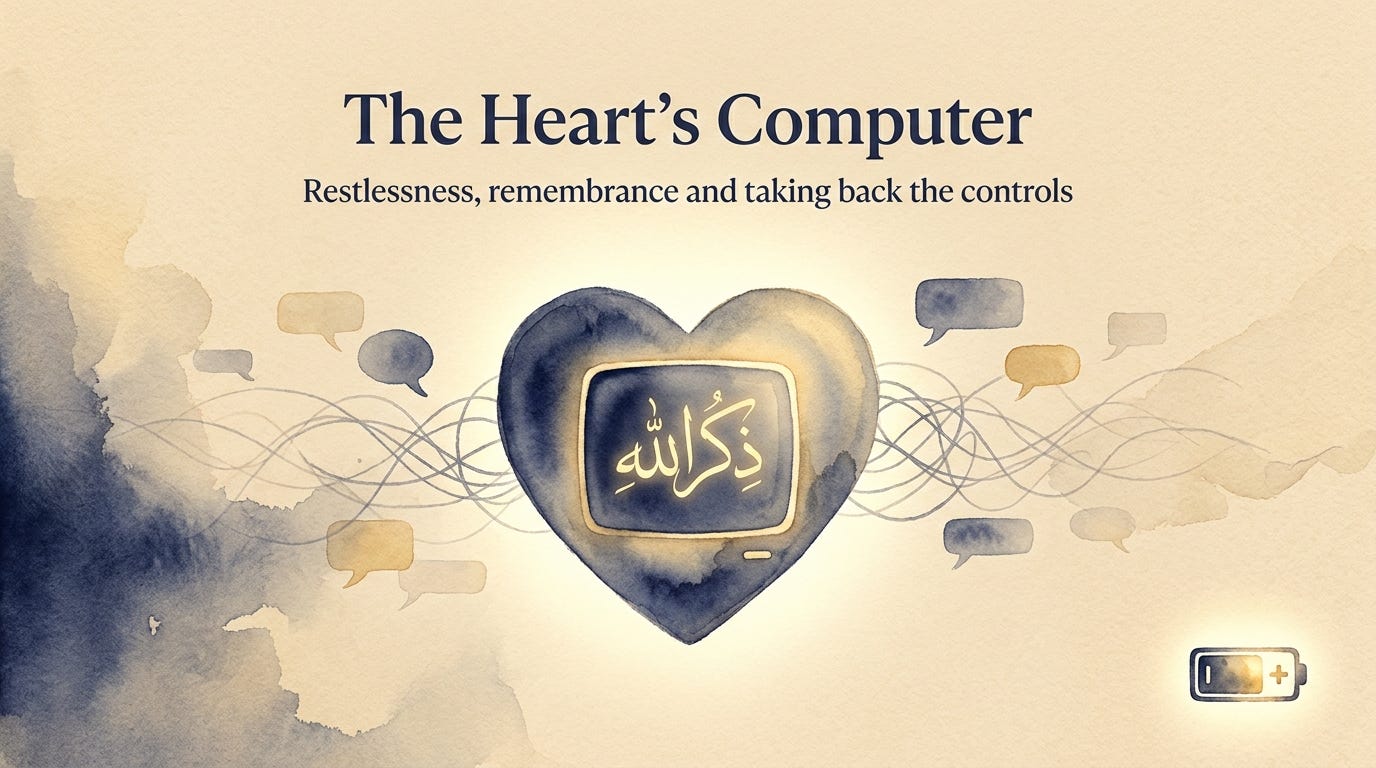
In some of the previous reflections, the heart was a sponge that soaks up whatever surrounds it. This time the image is a computer. It’s always on and always processing. The real question is who is giving it instructions.
Where were you, and what have you become?
The same text turns to the human being and addresses him by his highest title: O vicegerent of God on earth, why have you fallen into this disobedience that breeds calamity? Where were you, and what have you become?
Where were we? In the Garden, with Ādam and Ḥawwāʾ. What have we become? People who lie awake over an argument from three days ago.
It’s an uncomfortable question, and it’s meant to be. Everyone who says lā ilāha illā Allāh is supposed to put it to themselves.
The excuses of the self
We usually blame our restlessness on something outside us. If only I had a spouse, children, a home of my own. The lecture was blunt about this: those are the excuses of the nafs. Many of us were given exactly those things, along with every comfort of modern life, and we are still restless.
The text points somewhere else. If we grasp where calm really comes from, we will recover our original, innate peace and be pulled out of this “pit of misfortunes.” And where does it come from?
“Verily, in the remembrance of Allah do hearts find rest.” — Sūrat ar-Raʿd 13:28
The formula
What I liked about this lecture is that it didn’t stop at “do more dhikr.” It called it a formula and gave it parts. Fill the heart with the remembrance of Allah and with reflection (tafakkur), serve His creation for His pleasure, and give the light of the Divine a place inside you. Together, that is the medicine.
The warning attached to it comes straight from the Qur’an:
“O you who have believed, let not your wealth and your children divert you from the remembrance of Allah. And whoever does that, then those are the losers.” — Sūrat al-Munāfiqūn 63:9
The verse doesn’t call wealth or children bad. They’re the very things we ask Allah for. The danger is that the cares around them, the work and the deadlines and the bills and the school runs, slowly fill the whole screen until there is no room left for Him.
The lecture made a sobering point here. There are, it said, two billion Muslims who pray and turn toward the qibla, and still so little peace among them. Its answer was that we have let the remembrance slip.
Can I really be in charge of my heart?
Then came the part that surprised me most. Before anyone tries to teach or heal others, the text says, they must first have full mastery over the “telescope of the heart,” or, as it puts it another way, the computer of the heart. Clear the rust from the mirror. Take back the controls.
But isn’t the heart in Allah’s hands? The Prophet ﷺ used to pray: “O Turner of hearts, keep my heart firm upon Your religion” (Tirmidhī). So how can anyone talk about mastering their own heart?
The answer given was careful. Allah is the Turner of hearts, without any doubt. And He also speaks to a soul that has reached rest:
“O tranquil soul, return to your Lord, well-pleased and pleasing.” — Sūrat al-Fajr 89:27–28
So the soul can arrive at tranquillity. When it does, through remembrance, a person stops being pushed around by every craving. And about such people Allah says of Iblīs:
“Indeed, there is for him no authority over those who have believed and rely upon their Lord.” — Sūrat an-Naḥl 16:99
Mastery of the heart, then, isn’t independence from Allah. It’s closer to the opposite. The heart becomes hard to hijack because it’s leaning on its Lord, in health and in sickness, in wealth and in poverty, in sorrow and in joy.
How would I know?
The sign offered was very practical. You have some mastery over your heart when you aren’t dragged, against your will, into the idle talk around you. People argue about whose language or region is better, and you stay out of it. Someone starts on who bought a house with what money, and you let it pass. The talk turns to anger and revenge, and your tongue isn’t part of it.
Instead, the heart is busy with the love of Allah, with remembrance and reflection, and the hands are busy serving people.
It made me wonder how much of my own processing power goes into conversations I never chose to join.
Check your battery
One image from the lecture I keep coming back to. Our acts of worship, of the tongue, of wealth, of the body, are like messages. The heart is the device that sends them. Faith is the power supply.
Your phone can be in perfect condition, but with the battery at zero it sends nothing and receives nothing. The heart works the same way. With weak faith, our worship can look correct and still not get through. With a full charge the messages travel, and something comes back: light, understanding, nearness.
So the first instruction was simple. Check your battery, and keep it full with remembrance, reflection and good company.
Don’t be in a hurry
The last lesson was the gentlest. Don’t expect the whole world to be reformed in twenty years because you started a circle of dhikr. Don’t even expect it of yourself. Getting hold of your own heart is hard; the lecture spoke of “a hundred years’ journeying.”
A child doesn’t grow up in a day. Think how often it falls before it walks. A merchant gets cheated many times before he learns the trade. The soul needs that same patience, for ourselves and for the people around us. Sūrat al-ʿAṣr describes the ones who are not at a loss as those who “advised each other to truth and advised each other to patience” (103:3).
An old Persian verse quoted in the lecture says it well: I won’t take my hand from seeking until my wish is granted, or my soul reaches the Beloved, or it leaves the body.
A practice for this week
Once a day, before you pick up your phone, sit for a few minutes with dhikr. Notice how full the “battery” feels before and after.
When a conversation drifts into gossip or division, try staying quiet once, and just notice what it feels like.
Do one small act of service this week with the intention lillāh, for Allah.
Ask yourself the old question honestly: where was I, and what have I become?
The computer is running whether we like it or not. What matters is who’s at the keyboard.