

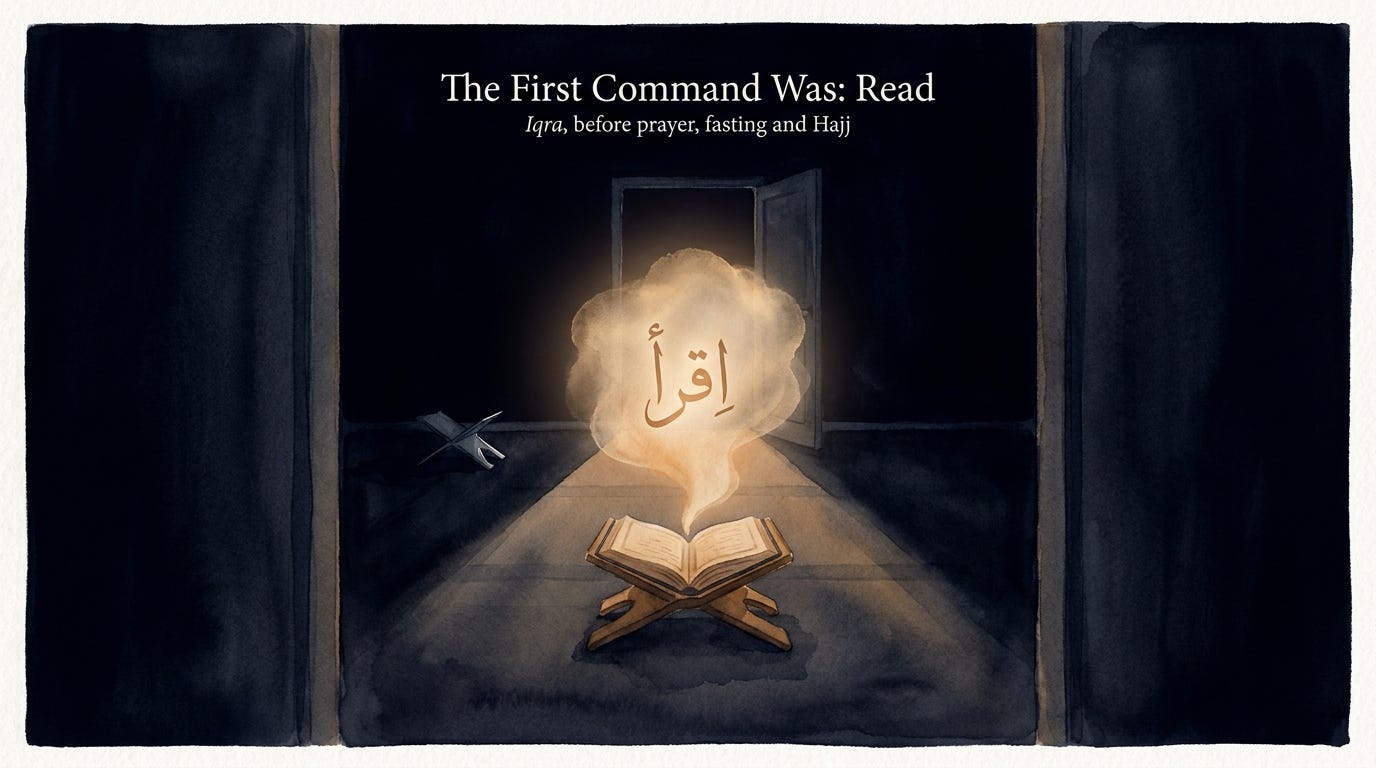
Before we were told to bow in prayer. Before we were told to fast. Before we were told to make Hajj. The first word that came down was one instruction: Iqra. Read.
Recently I came across a Hadith where Ṣaḥīḥ al-Bukhārī, ʿĀʾishah (ra) describes how revelation of the holy Quran began in the cave of Ḥirāʾ. The angel said “Read,” the Prophet ﷺ answered that he could not read, and the command was repeated. Then came the opening verses of Sūrat al-ʿAlaq:
“Read in the name of your Lord who created. Created man from a clinging substance. Read, and your Lord is the most Generous, who taught by the pen, taught man that which he knew not.” (Sūrat al-ʿAlaq 96:1–5)
So, even before prayer, fasting and Hajj, the first command was: Read!
So, why read first?
Because blind following has no foundation. A practice I don’t understand can be copied and repeated, even done beautifully, and still stand on nothing. The heart has to be guided by the mind.
There is a quieter reason as well. We can’t truly love what we don’t understand. Love for Allah, for His Messenger ﷺ, for the prayer itself, grows out of knowing them. Iqra.
Ignorance is the more dangerous state
I’ve come to think that ignorance is more dangerous than sin. A sinner can repent. But someone who doesn’t know? He doesn’t see anything to repent from. He normalizes the very things that are destroying him and holding him back, and calls it ordinary life.
Knowledge protects us from that kind of foolishness, and I believe this is why the Qur’an puts it before everything else. A real civilization is built on knowledge, the kind that leads to the highest values and opens up what is possible. The Qur’an puts the question plainly: “Say, are those who know equal to those who do not know?” (Az-Zumar 39:9)
A dark room
Imagine you’re standing in a room where you can’t see anything. How much effort would it take just to understand what’s around you? You’d have to touch every surface and every object, one at a time. Some of them might be sharp, and you could get hurt. There would be no other way, because you can’t see.
Now imagine someone turns on the light. Suddenly you see everything. You know at once what is dangerous and what is safe.
Reading works the same way. Constant reading and learning is the daily light that guides you through life and shows the path in front of you. Allah describes Himself as the ally of the believers who “brings them out from darknesses into the light” (Al-Baqarah 2:257). It seems fitting that the first thing He asked of us was to open our eyes.
Prayer, fasting and Hajj were all ordained later, to people who had already been told to read. So maybe the question for this week is a simple one: what have I read lately that actually turned the light on?