

This reflection continues the previous Ramadan Reflections (“The Heart’s Steering Wheel”). There, we looked at how a deed can begin for the sake of Allah, yet the heart can be re-steered mid‑journey. Today’s passage is a Qur’anic example of that same danger: how a being once placed in worship can, through pride, fall into open rebellion.
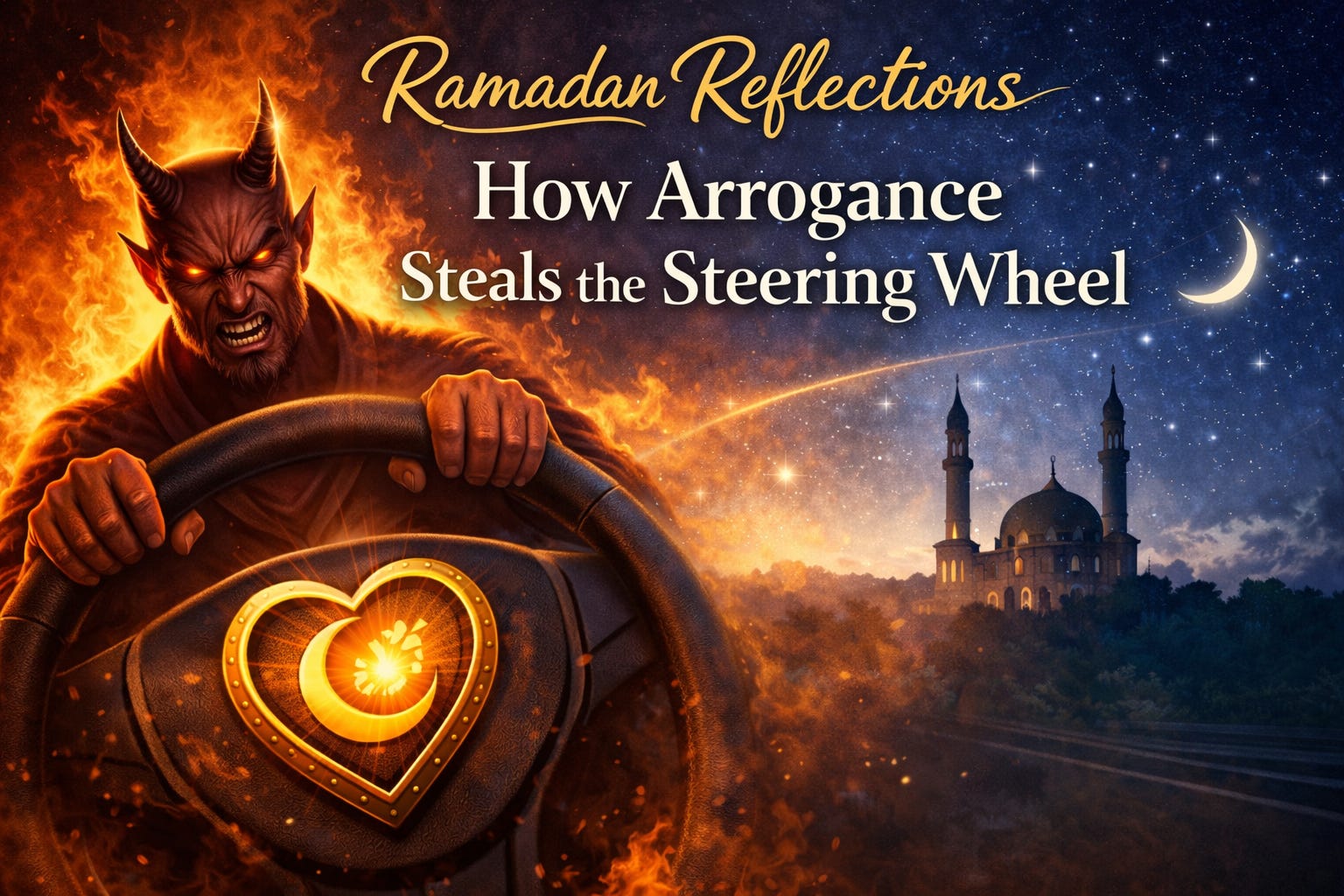
The Qur’an’s example: Iblis, worship ruined by arrogance
In the previous reflection, the question was simple but unsettling: Who is actually driving? The heart can be pulled by angelic inspiration or hijacked by ego, and a good start is no guarantee of a good ending.
Today’s story shows what that looks like when the steering wheel is seized by kibr (arrogance).
Qur’anic passage from Surah Al‑A‘raf (Surah 7)
11 We created you, We gave you shape, and then We said to the angels, ‘Bow down before Adam,’ and they did. But not Iblis: he was not one of those who bowed down. 12 God said, ‘What prevented you from bowing down as I commanded you?’ and he said, ‘I am better than him: You created me from fire and him from clay.’ 13 God said, ‘Get down from here! This is no place for your arrogance. Get out! You are contemptible!’ 14 but Iblis said, ‘Give me respite until the Day people are raised from the dead,’ 15 and God replied, ‘You have respite.’ 16 And then Iblis said, ‘Because You have put me in the wrong, I will lie in wait for them all on Your straight path: 17 I will come at them—from their front and their back, from their right and their left—and You will find that most of them are ungrateful.’ 18 God said, ‘Get out! You are disgraced and banished! I swear I shall fill Hell with you and all who follow you! 19 But you and your wife, Adam, live in the Garden. Both of you eat whatever you like, but do not go near this tree, or you will become wrongdoers.’
What this means (in line with Islamic teachings)
This passage (from Surah al-A‘raf) captures a pattern the scholars often point to: a person can have worship, knowledge, and even a long history of obedience, yet still be destroyed by pride when a test exposes what was hidden.
Here are the core lessons that Islamic teachings emphasize.
The fall begins with refusing a clear command from Allah. The command is explicit: bow. The moment Iblis refuses, the problem is no longer “a misunderstanding.” It becomes disobedience.
Iblis argues with Allah using ego, not truth. “I am better than him” is not a search for guidance. It is self-justification. In Islamic terms, it is kibr: seeing oneself as above the command.
Pride often disguises itself as “principle.” Iblis does not say, “I hate You.” Iblis presents a reason. But the Qur’an exposes the inner sickness: the reason is built on self‑exaltation.
Wrong comparison leads to wrong conclusions. Iblis compares “fire” and “clay” as if origin alone determines worth. But in Islam, honor is not by material, lineage, or rank. Honor is by obedience and taqwa.
The punishment is tied to arrogance. The reply is not only “leave.” It is “This is no place for your arrogance.” This teaches that arrogance is not a small character flaw. It is a spiritual poison that blocks repentance.
Even after the fall, Iblis asks Allah—but not for forgiveness. Iblis requests respite, and Allah grants it as part of divine wisdom and the unfolding test of life. But Iblis does not say, “Forgive me.” Instead, Iblis declares war on the straight path.
Satan’s strategy is a strategy of gradual steering. “I will come at them—from their front and their back…” is a description of persistence, repetition, and approach from multiple angles. The goal is not only one big sin. The goal is to keep a person drifting until gratitude and obedience weaken.
The Ramadan mirror
This is where it returns to the theme of the previous article.
A person can have a “high position” in outward deeds and still be at risk if the inner driver becomes:
self-admiration (“I am better”),
jealousy when Allah gives another person a blessing,
resentment when Allah’s decree does not match what the ego thinks it deserves.
Ramadan makes these inner movements easier to notice.
And this story gives a sober warning: it is possible to lose everything by refusing one command out of pride.
A practical takeaway
If the heart is the steering wheel, then one of the most important acts of worship is learning to say, quickly and sincerely:
“I was wrong.”
“O Allah, forgive me.”
“O Allah, protect me from arrogance.”
Because the difference between Adam and Iblis is not “who slipped.”
It is who returned.
Series: Ramadan Reflections
Link to previous reflection 👇
Ramadan Reflections: Who’s Holding the Steering Wheel?

📝 Ramadan Reflections is a series of short essays where reading turns into practice, and ideas get tested against the heart.