
Ramadan Reflections #9: Guarding the Heart’s Attention in Ramadan
🌙 Ramadan Reflections is a series of short essays where reflection turns into practice, and the heart returns to Allah.

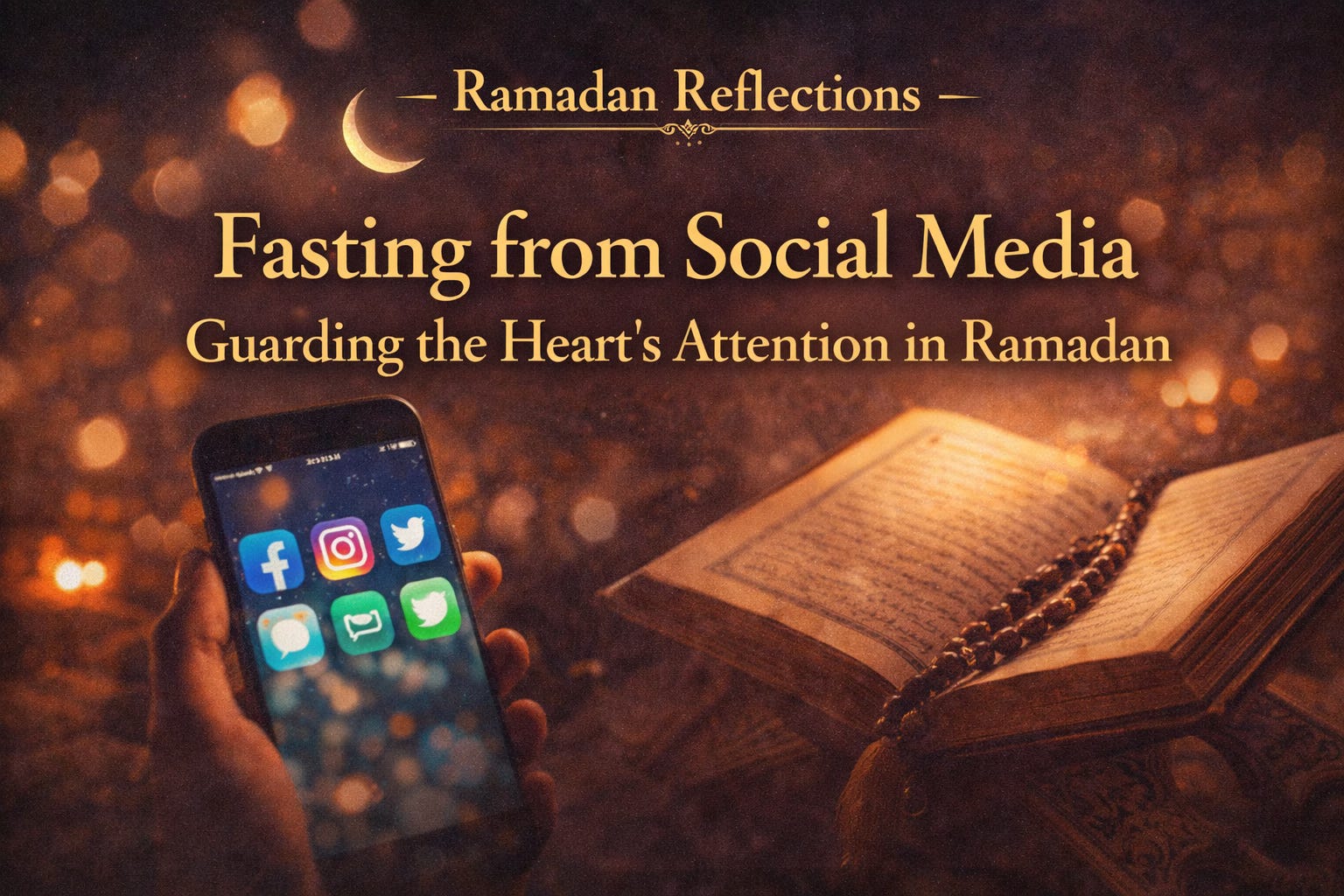
Sometimes guidance comes in the most ordinary places.
A few days ago, I walked into a cosmetics shop to buy one specific thing and leave. The whole visit lasted only a couple of minutes. But in the background, the shop was playing its own radio station: music, ads, and occasional interviews.
By coincidence, I walked in right as the radio host was talking about Christian fasting practices. This year, Ramadan and Lent overlap for many people, so the topic immediately grabbed my attention.
One point in the interview stayed with me. During Lent, many Christians choose a form of self-denial, often by giving up one luxury or habit for the season. Some people even choose to give up social media.
Hearing that, in the middle of a normal shopping trip, felt like a quiet reminder: if other people can step away from distractions for the sake of God, why do we so easily make peace with endless scrolling during Ramadan?
Ramadan does not only ask us to stop eating and drinking.
It asks a deeper question: what are we feeding our hearts every day?
For many people today, the most constant “food” is not bread or water.
It is attention.
And one of the most efficient machines for consuming attention is social media.
A shared language: “giving something up”
One of the more interesting things about fasting is that it appears across traditions in different forms.
In Christianity, for example, Lent is commonly described as a 40-day season leading up to Easter, associated with prayer, self-denial, and almsgiving. Many Christians also choose a personal practice for Lent, such as giving up a luxury or habit. (In many Western traditions, the season spans 46 days on the calendar because Sundays are treated differently, but the symbolic “40” remains central.)
That is why it can feel so striking to hear of people who decide to give up social media for Lent.
Not because this makes one tradition “better” than another, but because it reveals something universal:
human beings already know that some habits quietly take over the soul.
The quiet addiction of scrolling
It is easy to underestimate social media because it rarely feels like “a big sin.”
It is often framed as:
staying connected
keeping up with news
relaxing for a moment
learning something new
And sometimes, it really is those things.
But for many people, the dominant pattern is different.
Social media becomes a loop of:
constant novelty
constant comparison
constant stimulation
constant emotional pull
What begins as “a quick check” becomes an hour.
And an hour becomes a habit.
And a habit becomes a default.
Why this matters more in Ramadan
Ramadan is not just a month of “less.”
It is a month of replacing.
We do not only empty the stomach.
We try to fill the heart with what it was created for:
Qur’an
dhikr
duʿā
prayer
service
real community
And this is where social media becomes a serious challenge.
Not because every post is haram, but because it can consume the most precious thing Ramadan offers:
time with Allah.
Minutes are the currency of this month.
And every minute spent drifting is a minute that could have been used to return.
A more realistic goal: control, not fantasy
Many people feel stuck between two extremes:
“I will delete everything and never use social media again.”
“This is just how life works now, so there is no point trying.”
Ramadan invites a third way:
discipline.
Fasting trains the ability to say:
“I want to… but I will not.”
If the body can be trained to step away from what is halal for the sake of Allah, then the heart can also be trained to step away from what is distracting.
Not necessarily forever.
But deliberately.
With intention.
With boundaries.
A small Ramadan practice
Here is one simple practice that can help make the struggle concrete:
Choose specific windows for checking social media, instead of checking “whenever.”
Remove the apps that trigger mindless scrolling, or log out so it takes effort to re-enter.
Replace the reflex: when the hand reaches for the phone, reach for one small act instead.
one page of Qur’an
a short dhikr
a message to a family member
two rakʿahs
The goal is not to become perfect overnight.
The goal is to stop letting the phone steer the heart.
Closing
Sometimes Allah wakes the heart through the smallest moments.
A sentence overheard.
A reminder at the exact right time.
A door that opens for only a few minutes.
May Allah make Ramadan a month where our attention returns to what matters most.
May Allah protect our hearts from being scattered.
And may Allah replace distraction with presence, and presence with nearness. Ameen.
Thank you for a wonderful post. In an age where doomscrolling can take up hours of your day it is an important reminder that the point of Ramadan is to feed that spiritual connection with Allah rather than your physical vessel. Thank you for the reminded.