

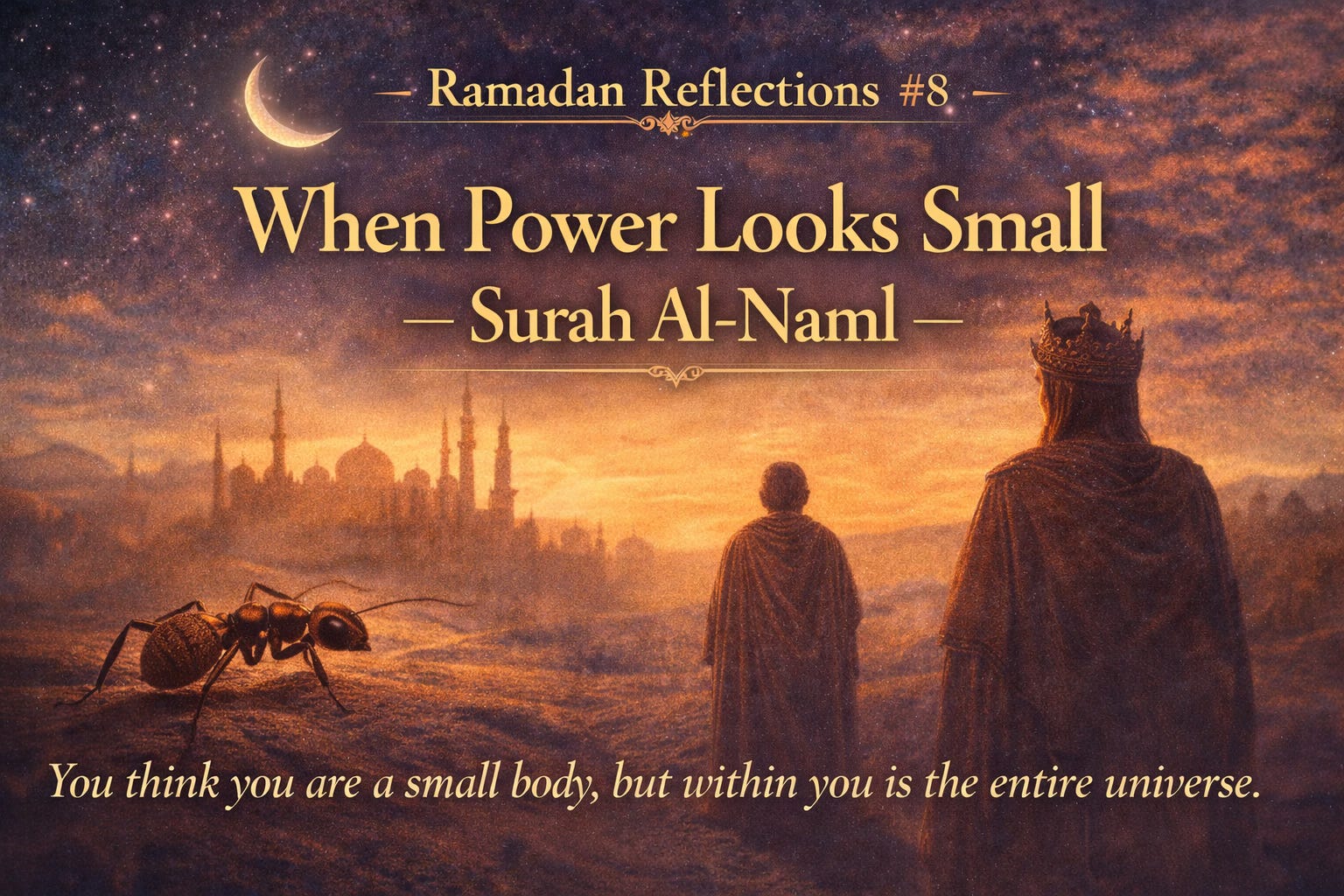
There are times when believers feel small.
Outnumbered.
Misrepresented.
Overpowered.
Surah Al-Naml (The Ant) was revealed in Makkah during a period when Muslims were few, socially pressured, mocked, and oppressed. The early believers had no political power, no military strength, no protection except their faith.
And into that atmosphere, Allah revealed a surah filled not with fear, but with stories of power.
Not human power.
Divine power.
The Makkan Background: A Surah of Strength in Weakness
According to classical scholars of tafsir, Surah Al-Naml is a Makkan revelation. The Muslims at that time were facing:
Ridicule from Quraysh
Social boycott
Psychological warfare
Threats and persecution
Being portrayed as misguided or dangerous
They were a minority. Public narratives were controlled by their opponents. Truth was dismissed.
And Allah did not respond by telling them, “You are many.”
He reminded them: I am greater.
Musa (as): When Tyranny Looks Absolute
The surah begins by recalling the story of Musa (peace be upon him) and Fir‘awn.
Fir‘awn had:
Military power
Political control
Media dominance (he publicly shaped narratives about Musa)
Public loyalty built on fear
Yet Allah says:
“Indeed, Fir‘awn exalted himself in the land…” (27:14)
Arrogance always looks stable — until Allah moves.
Musa (as) did not win because he had numbers.
He won because Allah was with him.
This is not a political message.
It is a spiritual one.
Oppression is loud.
Truth is patient.
The Ant: Small, But Heard by Allah
Then comes the story that gives the surah its name.
An ant warns its colony:
“O ants, enter your dwellings lest Sulayman and his soldiers crush you while they perceive not.” (27:18)
Sulayman (as) hears the ant — and smiles.
Think about that.
A creature almost invisible.
A voice almost silent.
Yet heard.
Allah includes the ant’s words in the Qur’an — recited for centuries.
This is hope for every believer who feels small.
You may feel unheard by the world.
You are not unheard by Allah.
Sulayman (as): True Power is Gratitude
Sulayman (as) was given extraordinary authority:
Control over wind
Jinn
Armies
Kingdom
Yet what does he say?
“This is from the favor of my Lord, to test me whether I will be grateful or ungrateful.” (27:40)
Even power is a test.
Even dominance is fragile.
Even success can become failure if it breeds arrogance.
Surah Al-Naml teaches that:
Tyrants fall.
Small voices matter.
Power belongs to Allah alone.
Gratitude protects the heart from corruption.
Today’s Pressure: Not Only Physical
Oppression today does not always come as chains.
Sometimes it comes as:
Narrative distortion
Constant negative media portrayal
Psychological exhaustion
Faith framed as backwardness
Endless images of suffering
It creates doubt.
It creates fatigue.
It whispers:
“Maybe you are on the wrong side.”
Surah Al-Naml responds:
No.
Truth is not measured by volume.
It is measured by revelation.
The Real Battlefield
The Qur’anic tradition teaches us that the greatest battlefield is not external — but internal.
The struggle is not first about numbers.
Or visibility.
Or dominance.
It is about the state of the heart.
When ego and fear dominate the heart, defeat begins long before any external loss.
But when the heart is anchored in tawheed, even apparent weakness becomes strength.
This echoes a famous insight attributed to Jalal al-Din Rumi:
“You think you are a small body, but within you is the entire universe.”
Outwardly, a believer may appear small.
Outnumbered.
Overpowered.
But inwardly — if the heart is connected to Allah — the scale shifts entirely.
Surah Al-Naml reinforces this pattern:
Fir‘awn had outer strength — inner corruption.
Musa had outer weakness — inner certainty.
Sulayman had outer power — inner humility.
The ant had outer fragility — inner awareness.
The Qur’an does not measure by size.
It measures by state.
Victory in Islam is first spiritual.
Because when the inner universe is ordered by tawheed, the outer world cannot truly overpower it.
Advice from the Surah
Strengthen Tawheed
Repeatedly, the surah calls to recognize Allah as the only true authority.Do not internalize propaganda
Fir‘awn shaped narratives. Allah exposed them.Stay grateful even in hardship
Gratitude is not denial of pain — it is trust in wisdom.Remember that scale deceives
An ant can be immortalized in revelation.
A king can be erased from history.Return to the Qur’an in times of confusion
The early Muslims did not have platforms.
They had revelation.
And it was enough.
Ramadan and Hope
Ramadan trains us to detach from noise.
When you fast, the world’s volume lowers.
The ego weakens.
The heart becomes clearer.
Surah Al-Naml reminds us:
You are not defined by how the world portrays you.
You are defined by your relationship with Allah.
Oppression may be part of the test.
But Allah’s promise remains constant:
Truth endures.
Arrogance collapses.
And every ant — every small believer — is seen.
May Allah strengthen our hearts like Musa.
Grant us humility like Sulayman.
Protect us from arrogance like Fir‘awn.
And make us grateful servants — even when the world misunderstands us.
Ameen. 🤲