
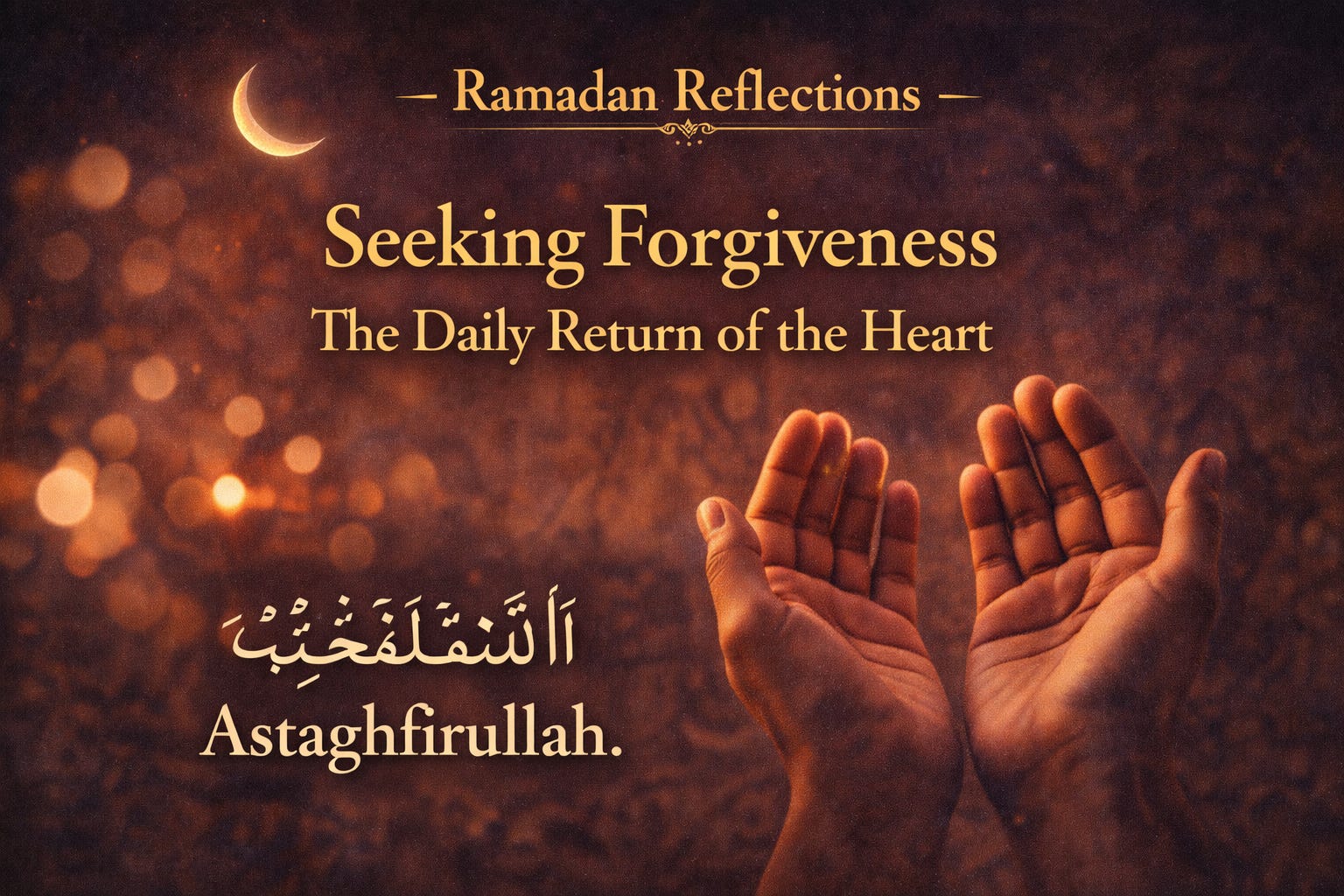
Ramadan Reflections #10: The Daily Return of the Heart - Seeking Forgiveness
🌙 Ramadan Reflections is a series of short essays where reflection turns into practice, and the heart returns to Allah.

Some of the most powerful teachings of Islam come in very simple forms.
One day, Abu Bakr — the closest companion of the Prophet ﷺ — asked him something deeply personal.
He said:
“O Messenger of Allah, teach me a supplication that I may say in my prayer.”
The Prophet ﷺ replied by teaching him a short duʿā:
“O Allah, I have greatly wronged myself, and none forgives sins except You. So forgive me with a forgiveness from You and have mercy on me. Indeed, You are the Most Forgiving, the Most Merciful.”
It is a striking moment.
If anyone could have assumed that his faith and closeness to Allah were already secure, it would have been Abu Bakr.
Yet the duʿā the Prophet ﷺ taught him begins with a powerful admission:
“I have greatly wronged myself.”
Not “others have wronged me.”
Not “my circumstances are difficult.”
“I have wronged myself.”
This is the language of spiritual honesty.
The Prophet’s own example
Even more remarkable is what the Prophet ﷺ himself said about forgiveness.
He once told his companions:
“O people, turn to Allah in repentance and seek His forgiveness, for I seek forgiveness from Him one hundred times a day.”
Think about what this means.
The Prophet ﷺ — whose past and future sins were forgiven — still returned to Allah in repentance every single day.
Not once.
Not occasionally.
But repeatedly.
This shows us something essential about the spiritual life.
Seeking forgiveness is not only for those who have committed major sins.
It is the daily returning of the heart.
Why forgiveness matters so much
Every day leaves traces on the heart.
A careless word.
A moment of pride.
A wasted hour.
A small injustice.
Most of these moments pass unnoticed.
But the Qur’an and the Prophetic teachings repeatedly remind us that hearts can slowly become covered by the weight of neglect.
Seeking forgiveness is how the heart is cleaned.
It is the act of stopping for a moment and saying:
“My Lord, I need Your mercy again.”
And again.
And again.
Ramadan: the perfect time to rebuild this habit
Ramadan is often described as a month of fasting.
But in reality, it is a month of returning.
Returning to the Qur’an.
Returning to prayer.
Returning to sincerity.
And returning to forgiveness.
This is why many scholars encourage a very simple practice during Ramadan:
Repeat “Astaghfirullah” throughout the day.
While walking.
While waiting.
While driving.
While resting.
Just a quiet admission of need.
A quiet return to Allah.
A small practice
If you want a simple habit to carry through Ramadan, try this:
Set a goal of 100 times a day.
Not rushed.
Not mechanical.
Just small pauses throughout the day where the heart remembers its need for mercy.
The Prophet ﷺ did this constantly.
And if he needed forgiveness every day, how much more do we?
Closing
One of the quiet secrets of the righteous is that they never outgrow repentance.
The closer someone comes to Allah, the more aware they become of their need for Him.
Ramadan invites us into this same rhythm.
A rhythm of returning.
A rhythm of humility.
A rhythm of saying, again and again:
Astaghfirullah. 📿