

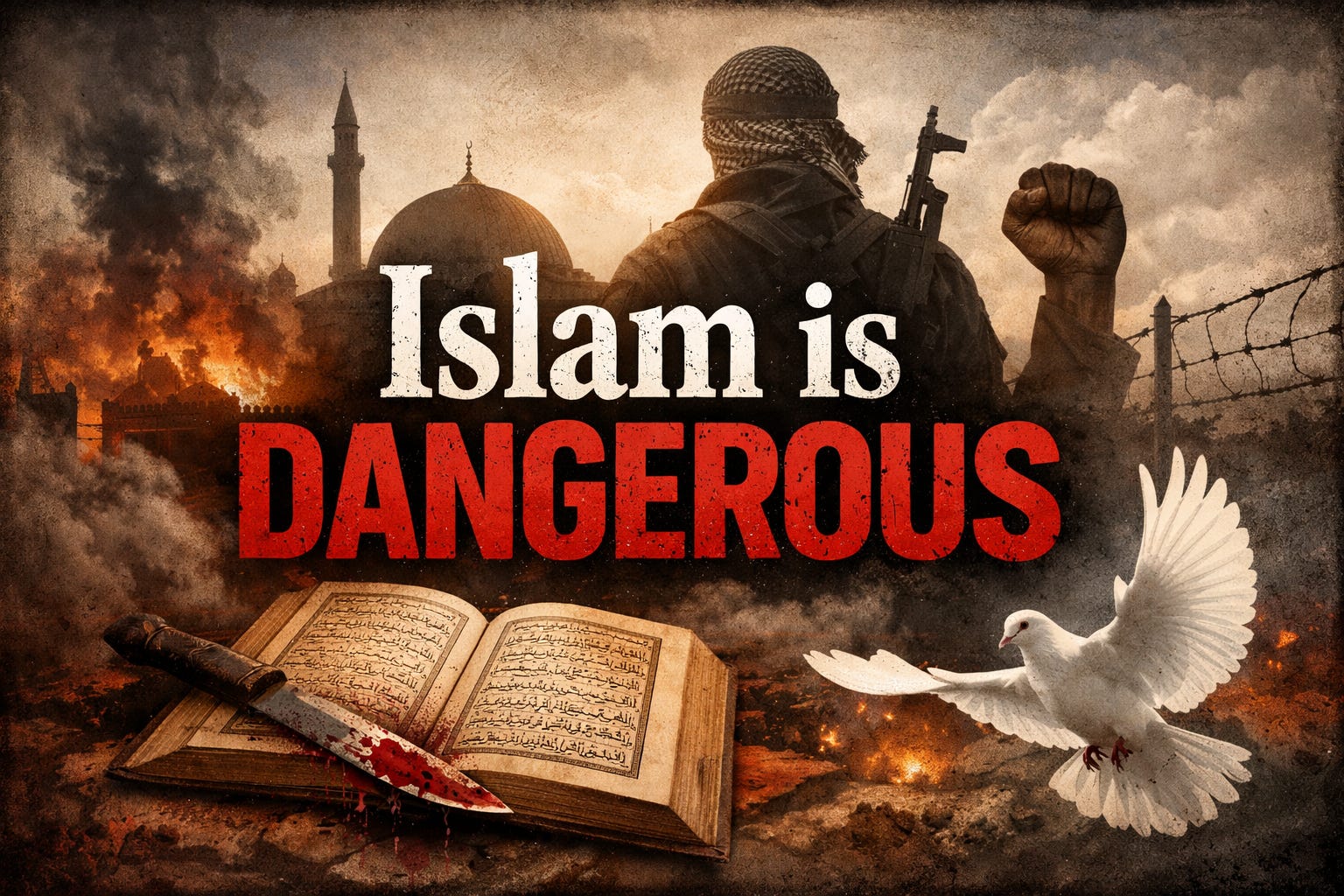
Islam is dangerous when it is placed in the hands of people who want power more than truth.
It is dangerous when ordinary believers, who genuinely want to please God, are taught to confuse obedience to a leader with obedience to Allah. It is dangerous when religion is reduced to slogans, when complex guidance is replaced by “rules” that conveniently serve someone’s interest. It is dangerous when fear is preached as faith, and control is sold as piety.
And it is dangerous when those who suffer under oppression are told that their suffering is “Islamic.”
Because then the victim is trapped twice: trapped under injustice, and trapped under the belief that questioning injustice is questioning God.
This is why, in public conversations today, people often say things about “Islam” that are actually descriptions of human abuse, political abuse, institutional abuse, even scholarly abuse. When I hear those critiques, I often find myself agreeing with the facts being described. What I wish would change is the conclusion. The conclusion is too often: “Islam is the oppressor.”
But the Qur’an and its teachings are not the oppressor. The people who misuse them are.
How faith becomes a tool of control
Many people approach Islam with sincerity. They love God. They want to obey. They want guidance, structure, and meaning. And Islam is powerful precisely because it speaks to the heart and conscience.
That sincerity is a blessing but also a vulnerability.
When a person is not well informed, they may accept anything that comes wrapped in religious language: a harsh opinion, a political directive, a cultural habit, even cruelty, so long as it is stamped “Islam.” That is how religion gets weaponized: not through deep scholarship, but through shallow certainty.
And once religion is weaponized, oppression becomes easy to justify. Leaders can present their own policies as divine will. Institutions can demand loyalty by calling it faith. Some scholars may support it, intentionally or unintentionally, by repeating interpretations that serve authority rather than justice.
This is not a “Muslim problem” alone. It is a human problem: people use whatever is sacred to others as a lever to move them.
How Islam is attacked by the same method
There is a particularly damaging misuse that often comes from the outside: taking small fragments of Islamic teachings and turning them into accusations—snippets detached from their setting, then presented as if they are the whole faith.
Interestingly, even the introduction to a respected Oxford translation of the Qur’an explicitly warns about this. It notes that Qur’anic phrases can be lifted from their textual and historical context and then repurposed as standalone slogans, sometimes by non-Muslims looking for “proof” against Islam, and sometimes by extremists trying to justify themselves.
A well-known example is the Qur’anic verse often rendered as “Kill them wherever you encounter them” (2:191). Read in isolation, it sounds like a general command. But the same introduction points out a basic grammatical fact: the “them” refers back to “those who attack you” in the preceding verse, meaning the text is not speaking about random people, but about a specific situation of aggression.
And if we actually look at the passage where this occurs (2:190–195), the framing becomes difficult to ignore: the permission to fight is tied to self-defence, surrounded by restraint, and repeatedly bounded by moral limits. The opening instruction sets the tone clearly:
“Fight in God’s cause against those who fight you, but do not overstep the limits.”
Then the same passage continues with conditions: do not initiate aggression, stop when the other side stops, and treat “persecution” and forced oppression as the reason conflict is addressed in the first place. In other words, this is a framework of self-defence, not a blank cheque for violence.
The Oxford introduction makes a similar point about what critics sometimes label “the sword verse” (9:5). One clause is regularly pulled out and treated as Islam’s universal policy on war, while the surrounding passage explains the context, broken treaties, ongoing hostility, and even includes an explicit instruction to protect enemies who seek safe conduct and escort them to safety (9:6).
This is the pattern: isolate a fragment, remove the surrounding conditions, and weaponize the result. Once that method becomes normal, it becomes easy to make Islam look inherently violent or oppressive, without having to engage honestly with what the text is actually doing.
The truth: Islam promotes peace and restrains violence
Here is the turn that matters, and the one I want the reader to sit with:
Islam is “dangerous” only in the way that any moral system is dangerous. Because it can be misused by someone who brings violence into it.
But Islam itself does not invite violence as a default posture. The Qur’an repeatedly calls people toward inner peace, moral restraint, human dignity, and justice—principles meant to shape everyday life long before anyone speaks of conflict.
It speaks to freedom of conscience in a way that leaves no room for coercive “faith”:
“There is no compulsion in religion: true guidance has become distinct from error…” (2:256)
It describes peace as something that begins inside the human being. Something tied to remembrance, humility, and clarity of heart:
“Those who have faith and whose hearts find peace in the remembrance of God—truly it is in the remembrance of God that hearts find peace—…” (13:28)
It teaches believers how to carry themselves in ordinary social life: not as people looking for confrontation, but as people trained in dignity and calm:
“The servants of the Lord of Mercy are those who walk humbly on the earth, and who, when the foolish address them, reply, ‘Peace’.” (25:63)
It frames human diversity as a reason for recognition and humility, not superiority and hatred:
“People, We created you all from a single man and a single woman, and made you into races and tribes so that you should recognize one another…” (49:13)
It pushes the believer toward emotional discipline—because anger is easy, but restraint is moral strength:
“…who restrain their anger and pardon people—God loves those who do good—…” (3:134)
And it summarizes a broad ethical program that directly contradicts oppression:
“God commands justice, doing good, and generosity towards relatives and He forbids what is shameful, blameworthy, and oppressive…” (16:90)
This is why I say the Qur’an is not a political marketing kit. It is meant to be guidance: to form character, discipline the ego, demand justice, and call people to responsibility before God. It speaks to how you treat your neighbour, your family, the stranger, the person you disagree with, and even how you manage your own impulses.
So when Islam is presented mainly as a tool of coercion, something has been inverted.
Why context is not optional
One reason these distortions spread so easily is that the Qur’an has a concise style and often alludes to events without narrating the full historical background. Those who first heard it understood the circumstances; later readers relied on reports about the occasions of revelation and scholarly commentary.
This is why “context” is not a modern excuse. It is part of how Qur’anic interpretation has always worked.
And it is why simplistic readings, whether hostile or extremist, are so dangerous. They do not merely misunderstand the Qur’an; they repurpose it.
Islam’s relationship with “the other”
Another reason I resist the claim that Islam is inherently oppressive is that the Qur’an repeatedly insists on moral seriousness in how Muslims relate to others.
The introduction in the Oxford Qu’ran translation cites explicit Qur’anic instructions for engaging the People of the Book with what is “best,” emphasizing shared belief in one God, and urges communities to “race to do good,” even while acknowledging differences.
Whatever politics people attach to Islam today, these principles are not marginal—they are plainly stated.
What I want to say, from the heart
So yes, Islam is dangerous.
It is dangerous to tyrants, because it calls them to account.
It is dangerous to propagandists, because it demands truth.
It is dangerous to anyone who wants obedience without ethics, law without mercy, identity without responsibility.
And it becomes dangerous to ordinary people only when it is hijacked, when faith is used as a mechanism of control, and when scripture is treated as a set of weapons rather than a source of guidance.
My advice, especially to Muslims, is simple and difficult at the same time:
Do not outsource your conscience. Verify what you hear. Be cautious of translations and interpretations that consistently generate hatred, cruelty, or arrogance. The Qur’an’s own framing of warfare passages, as the introduction shows, is restrictive and conscience-awakening, not unlimited and celebratory.
And to non-Muslims reading this: criticize oppression clearly—please do—but name it accurately. If a policy harms people, say so. If a leader abuses religion, say so. If a preacher spreads hatred, say so. But do not confuse Islam with its abusers.
Islam is not the problem.
People are.
Appendix: about this post
This is not a usual post for me. I felt I needed to write it because of what has been happening in the world over the last couple of years, and the way Islam keeps being pulled into narratives of fear, blame, and simplification. I have tried to avoid sounding political or taking sides. Politics has never been my focus, and this piece is not intended to argue for any political camp.
If you want to explore these themes in more depth, there is extensive research and discussion available from a wide range of perspectives. My aim here was narrower: to point to a recurring pattern using only a few limited examples. The reality is far more complex than what can be captured in a single blog post.
In writing this, I drew on Islamic literature, ideas I have encountered in debates and public discussions, and my own understanding, informed by what I have learned over time. Any shortcomings in how I expressed these points are mine, and I welcome corrections grounded in research, intellectual honesty, and a commitment to justice.