

The last reflection ended with an image: the heart as a sponge. It soaks up whatever it sits in, and dhikr is the clean water that rinses it out.
I want to stay with that water for a while. Less theory about the heart this time, more about the practice. What remembrance actually asks of us, why Allah asks for so much of it, and one short phrase that closed a lecture I listened to recently, given to everyone there as their task for the month.
A command with no number
Most worship in Islam comes with a measure. Five prayers a day, one month of fasting, a fixed share for zakāt. Remembrance doesn’t.
“O you who have believed, remember Allah with much remembrance, and exalt Him morning and evening.” (Sūrat al-Aḥzāb 33:41–42)
The word is kathīr, much. It has no ceiling. Three times is a start, and so is a hundred.
The reason the lecture gave for this was simple and very human. We get attached to what we repeat. That is how habits form, the good ones and the bad ones. Someone who never builds a habit of remembering will still end up with habits, just not ones they chose. A heart doesn’t stay empty for long. If nothing good is put in it, it fills up with whatever is nearest: a feed, a worry, the wish to be noticed.
Seen that way, the open number is a mercy. It’s an invitation to let remembrance be the thing we keep coming back to.
Where remembrance should land
Scholars of the heart often describe two places dhikr should reach. One is the mind, which plans and doubts. The other is the heart, which loves and fears and quietly decides where the feet will go.
The Prophet ﷺ said: “Truly, in the body there is a morsel of flesh; if it is sound, the whole body is sound, and if it is corrupt, the whole body is corrupt. Truly, it is the heart.” (Narrated by an-Nuʿmān ibn Bashīr, Ṣaḥīḥ al-Bukhārī 52 and Ṣaḥīḥ Muslim 1599)
When lā ilāha illā Allāh is said with attention, both are involved. With lā ilāha the mind lets go of what it was wrongly leaning on. With illā Allāh the heart holds on to the One who remains. Said absent-mindedly, they are still good words. Said with presence, they slowly change how we walk into the day.
The lecture tied this to prayer as well. Ṣalāh has its movements and its recitation, but without remembrance behind them it can turn into something we get through instead of a standing before Him. Dhikr outside the prayer is a kind of training for being present inside it.
“My Lord is enough for me”
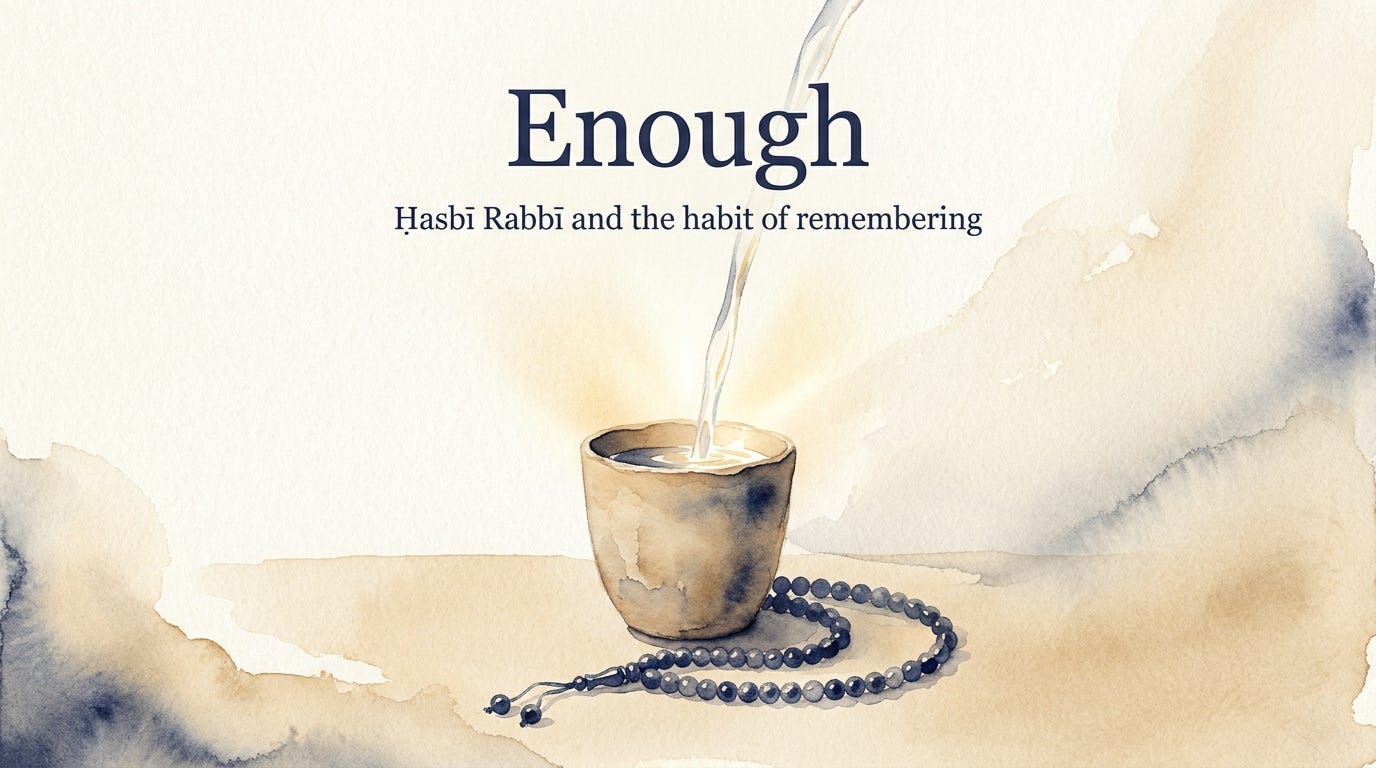
The phrase for the month was Ḥasbī Rabbī jalla-Llāh: my Lord is enough for me, exalted is Allah.
It’s short enough for the walk to work or the queue at the supermarket. It carries more than its length suggests.
Ḥasbī means He is sufficient for me. Not my salary or my plans or what people think of me. The idea runs through the Qur’an:
“Say: Allah is sufficient for me; there is no deity except Him. On Him I have relied, and He is the Lord of the Great Throne.” (Sūrat at-Tawbah 9:129)
And when the believers were warned that people had gathered against them, their answer was:
“Allah is sufficient for us, and He is the best Disposer of affairs.” (Sūrat Āl ʿImrān 3:173)
Rabbī, my Lord, makes it personal. This is the One who provides for me and looks after me, not a distant concept. Then jalla-Llāh, exalted is Allah, lifts the eyes again. Whatever I’m anxious about right now, He is greater.
Said slowly, the phrase moves from need to trust and ends in praise.
Starting small
The advice that came with the task was generous. Forty-five minutes is good. Five minutes is a fine place to begin. Five minutes every day will do more than an hour once in a while, because the whole point is repetition.
There was also a word for parents: sit with your children for ten or fifteen minutes in the morning and remember Allah together. No test, no pressure. A few minutes a day turns into something real over a year, and children carry it with them into the years when the pull from outside is strongest. If they never learn to fill their hearts with remembrance, the world will gladly fill them with something else.
A practice for this week
Choose one fixed moment each day, after Fajr or before sleep, and repeat Ḥasbī Rabbī jalla-Llāh slowly for five minutes.
When a worry arrives, say it once and notice what you were leaning on a second before.
Say lā ilāha illā Allāh a few times with full attention.
If you have children, invite them to join you for a few minutes in the morning.
Before you sleep, ask what your heart soaked up today.
Allah’s promise is plain: “So remember Me; I will remember you.” (Sūrat al-Baqarah 2:152) And elsewhere: “Unquestionably, by the remembrance of Allah hearts are assured.” (Sūrat ar-Raʿd 13:28)
So here is the question I’m carrying into this week:
What does my heart repeat when I’m not paying attention?