

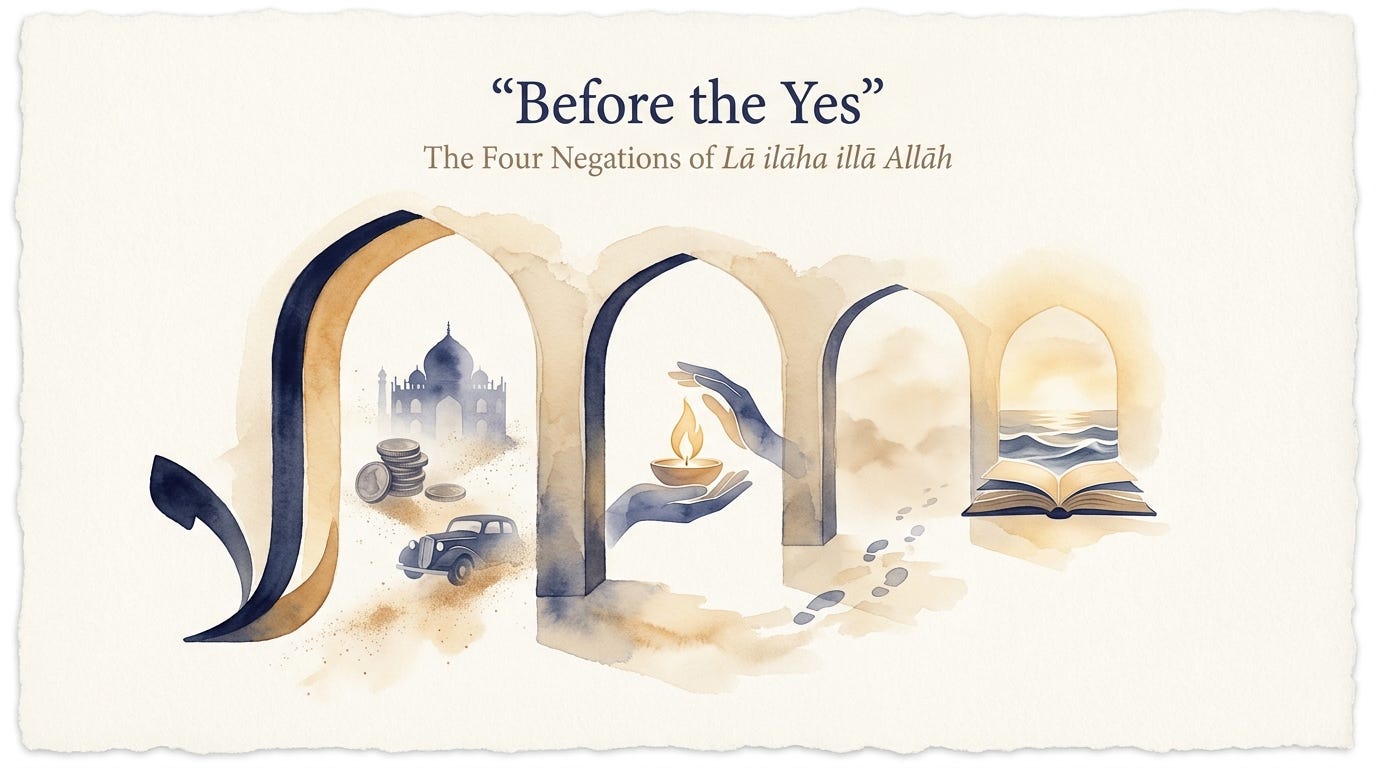
Every Muslim knows the sentence. Few of us notice that it begins with a refusal.
Lā ilāha — there is no god. Only after that: illā Allāh — except Allah.
The declaration of faith does not open with an affirmation. It opens with a clearing. Before the heart can say yes to the One, it has to say no to everything that has quietly taken His place. And that “no” is not said once. It is said again and again, at deeper and deeper layers, for a whole life.
In some previous reflections, we asked why humanity, with all its intelligence, still walks without direction — and whether we, as Muslims, have truly lived the tawḥīd we claim. This reflection turns that question inward and makes it practical. If tawḥīd is a direction, what stands in the way? What exactly must be negated?
The teachers of tazkiyah — the purification of the soul — describe this journey as four levels of negation (nafy). Each one is subtler than the one before. Each one removes an idol we thought we had already left behind.
The first no: the idols outside
The first level is the most visible. It is the rejection of false lords and false power.
The Qur’an and its commentators point to familiar figures: Firʿawn, who claimed lordship over a people; the tyrant whom tradition names Namrūd, who argued with Ibrāhīm about his Lord; Qārūn, who insisted his treasure came from his own knowledge; Āzar, who shaped idols and called people to them. They are not only figures of history. They are patterns. Arrogance in power. Self-made wealth. Devotion to what we have built with our own hands.
Today these idols rarely look like statues. They look like a salary, a position, a body, a house, a car, a name people recognize. None of these things is evil in itself. They become idols when the heart leans on them — when we feel safe because of them, worthless without them, and anxious every time they are threatened.
When the heart is crowded with such things, it becomes a quiet temple of idols. The first lā is the decision to empty that temple: to keep using the world, but to stop worshipping it. To know that power and permanence belong to Allah alone.
The second no: the idol of the self
A person can walk past every statue in the world and still kneel to one idol: their own desire.
This is the nafs — the lower self — with its hawā, its pull toward whatever it wants, whenever it wants it. The Qur’an asks a piercing question: “Have you seen the one who takes his own desire as his god?” (Al-Jāthiyah 45:23). You can be free of every external idol and still be ruled from within.
This is why Ramadan matters so much on this path. For a month, we refuse what is normally permitted — food, water, intimacy with our spouses — for no reason except Allah. It is a school for one skill: the ability to say no to yourself. Whoever learns to refuse the lawful for His sake finds it easier to refuse the unlawful: the convenient lie, the small deception, the glance, and the relationship that lead toward what Allah has forbidden.
The second lā is not a single victory. It is a training. Each time we hold back for His sake, the ego loses a little of its throne.
The third no: the voice that whispers
The third level is harder to see because the enemy doesn’t stand in front of us. He speaks from behind our own thoughts.
Shayṭān rarely asks a believer to do something terrible all at once. He asks for one small step. Then another. The whisper (waswasa) is sweet, reasonable, almost kind. This is why Allah warns us not only against sin, but against the path that leads to it:
“O you who believe, do not follow the footsteps of Shayṭān.” — Sūrat an-Nūr 24:21
And the remedy He gives is wholeness:
“O you who believe, enter into Islam completely, and do not follow the footsteps of Shayṭān. Indeed, he is to you a clear enemy.” — Sūrat al-Baqarah 2:208
Partial submission leaves doors open. The whisper finds the room we have kept for ourselves — the corner of life we have not yet given to Allah — and settles there. The third lā is the refusal to keep such rooms. Inner and outer, private and public, worship and work: all of it is part of Islam.
The fourth no: “I know”
After the outer idols, after the ego, after the whispers, one more idol remains — and it is the most dangerous, because it often grows out of spiritual progress itself.
It is the quiet sentence: I know.
I understand. I have arrived. I see clearly what others do not. This is intellectual pride, and it can sit comfortably in the heart of someone who prays, fasts, and studies.
The teachers use an image: the human mind is like a swimmer standing at the shore of an endless ocean. The swimmer can enter. The swimmer can go deep. But the swimmer cannot reach the other side. Divine knowledge has no shore that our reason can touch.
Even the angels, when asked about what they had not been taught, answered:
“Glory be to You. We have no knowledge except what You have taught us.” — Sūrat al-Baqarah 2:32
The fourth lā negates the claim to independence — of mind, of self, of importance. It is the station where the servant finally stops presenting himself, even silently, even to himself.
What remains after the no
When the four negations have done their work, something remains — and it is not emptiness.
The masters of this path speak of fanāʾ, the ego’s falling away and its claims, and baqāʾ, living on through Allah, where the servant’s actions are moved by guidance rather than by self. They point to the verse revealed about the Battle of Badr:
“And you did not throw when you threw, but it was Allah who threw.” — Sūrat al-Anfāl 8:17
We should use such words carefully. They describe stations reached by grace, not by ambition, and they are not something anyone should claim for themselves. But they show the direction: the more the self steps aside, the more the servant becomes an instrument of something greater than the self.
What keeps the heart on this path is remembrance. The heart is like a sponge. Placed in an environment of constant noise, comparison, and consumption, it absorbs it all without noticing. Abundant dhikr washes it out and fills it again with what it was made for. Allah mentions “the men and women who remember Allah much” among those for whom He has prepared forgiveness and a great reward (Al-Aḥzāb 33:35).
A practice for this week
When the world feels too loud, recite Sūrat al-Kāfirūn slowly — a whole sūrah built around saying no to false worship.
Keep the kalimah on your tongue, but pause at the lā. Ask: what am I negating today?
Read Sūrat al-ʿAṣr and ask whether you’re losing time or investing it.
Take a few minutes of tafakkur — silent reflection — at the end of the day.
Before ordinary tasks — work, family, earning — renew the intention: lillāh, for Allah.
The declaration begins with no, so that the yes can be true. Every idol we refuse makes room. And a heart emptied of everything else is the very heart Allah describes as the only thing that will benefit on the Day when neither wealth nor children benefit: qalbun salīm, a sound heart (Ash-Shuʿarāʾ 26:88–89).
So the question for today is simple, and not easy:
Which lā am I still standing in front of?